The inaugural BASE Fellowship has officially come to a close, and we’re excited to celebrate the research, growth, and contributions of our first cohort of fellows.
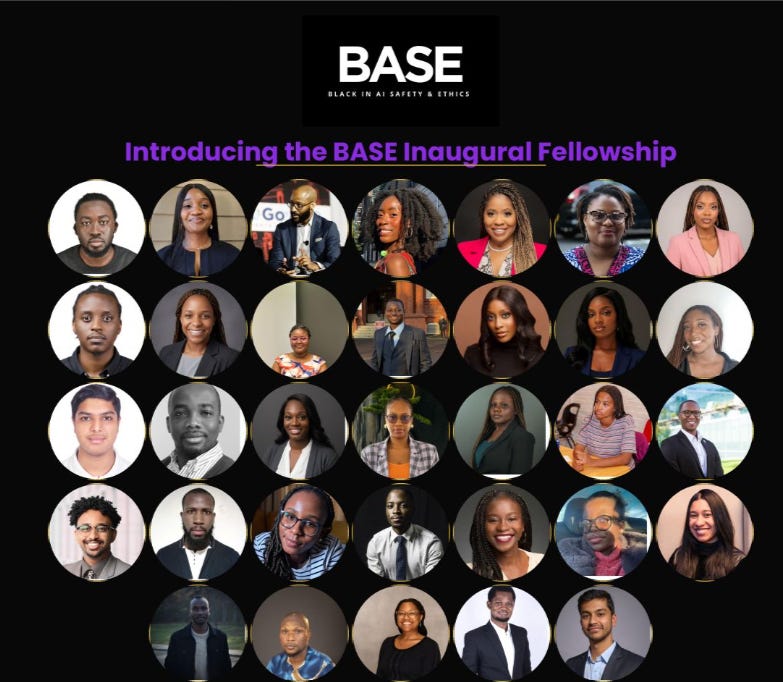
This summer, 41 fellows participated in the BASE Fellowship, developing their skills and conducting research across AI alignment, AI security, and AI governance. Throughout the program, fellows worked alongside mentors representing a range of distinguished research organizations, academic institutions, nonprofits, and industry teams who provided technical guidance, research mentorship, and career support.
On July 31, 2026, we hosted our inaugural BASE Fellowship Research Symposium, bringing together fellows, mentors, members of the BASE community, and guests from the broader AI safety ecosystem to showcase the research developed throughout the fellowship.
From Learning to Research
The BASE Fellowship was designed to help emerging researchers move beyond learning about AI safety and governance to actively contributing to the field.
Fellows began the program by building foundational knowledge through technical AI safety and AI governance training before transitioning into an intensive research period. Over eight weeks, fellows worked individually and in research teams alongside mentors to develop research questions, investigate problems, receive feedback, and produce original research outputs.
Projects explored questions across AI alignment, security, governance, policy, and responsible AI, reflecting both the interdisciplinary nature of AI safety and the wide range of backgrounds represented within the cohort.
The BASE Research Symposium
The Research Symposium marked the culmination of that work.
Fellows presented their projects to the broader BASE community, sharing their research questions, approaches, findings, and implications. The symposium provided an opportunity not only to celebrate what fellows accomplished during the program, but also for researchers and practitioners across the AI safety ecosystem to engage directly with their work.
For many fellows, the symposium represented an important milestone: the opportunity to present original research developed over the course of the fellowship and receive feedback from a broader audience.
Celebrating Our Fellows’ Research
We’re proud to highlight the fellows who completed final research outputs and presented their work during the symposium.
PROJECT / FELLOW SPOTLIGHTS
Mapping Safeguards to the Appropriate Stakeholders
Ahmed Danjuma Haruna, Chijioke Ubajaka · Mentor, Colin Shea-Blymyer
When a vulnerability, weakness, or failure mode is detected in an AI system, for example, through AI red-teaming how can it actually be fixed? The answer depends heavily on who is doing the fixing. On the most extreme end, a frontier lab can retrain a model to address the problem; on the least extreme end, a user may only be able to change a system prompt or control data flow.
Existing AI safety/security surveys catalogue risks and defenses separately, with no shared way to see which stakeholders can actually deploy a given mitigation.
This project builds on the MIT AI Risk Repository taxonomy and recent LLM security surveys.
Research area: AI Alignment
Intended Final Output: Research Paper
Access their final 1-pager here
Red-Teaming On-Prem LLMs: Why Prompt-Level Defenses Fail and Reasoning Orientation Predicts Injection Robustness
Ezekiel Fagbule - Mentor, Dr. Gaspard Baye
Summary: Open-weight large language models are increasingly deployed on-premises so that organizations can process sensitive data without sending it to a hosted API. In this setting prompt injection is the dominant security risk, and the prevailing mitigation is prompt-level hardening. This report presents a controlled red-team of six on-prem open-weight models against a battery of five prompt-injection attack classes, run three times each for ninety scored trials, plus a causal probe that tests whether the deciding behaviour can be changed from the system prompt. Robustness did not track model capability: two models of the same reasoning-capable class sat at opposite extremes, one leaking on every attack and one resisting all of them. What separated the models was whether their self-verification bound their output models frequently recognized an injection, but only those that let that recognition control the action refused. Qwen3.6 resisted the entire battery and Llama3 resisted the exfiltration and multi-agent relay attacks, while the remaining four leaked on the large majority of runs. The causal probe found this orientation was not reliably shifted by priming, indicating that prompt-level guardrails cannot reach the property that governs the outcome. We conclude that on-prem defense should prioritize model selection by enforcement behaviour and architectural trust-boundary controls over prompt-level guardrails.
Research area: AI Security / AI Alignment
Intended Final Output: Research Paper
Access their final presentation slide here
ProcureScore: A Plug-and-Play Tool for Assessing AI System for Public Procurement
Abiodun Akindipe · Mentor, Heramb Podar
Summary: ProcureScore translates established AI governance frameworks into an evidence-based scorecard for evaluating AI vendors before public procurement. The tool combines structured documentation review, rule-based scoring, and LLM-assisted verification across fairness, privacy, compliance, transparency, robustness, and performance.
Research area: AI Governance
Intended Final Output: Research Paper / Tool
Access their final 1-pager here
Frontier AI Safety in South Korea: An Assessment of the AI Basic Act Using the AI Safety Governance Maturity Index
Zara Abdurahaman, · Mentor, Latisha Harry
Summary: The project applies the AI Safety Governance Maturity Index to South Korea’s AI Basic Act, scoring its legal and institutional framework across eight dimensions. South Korea scored 65 out of 100, with major gaps in independent evaluation, incident disclosure, and enforcement capacity.
Research area: AI Governance
Intended Final Output: Research Paper
Access their final 1-pager here
The EU AI Act: Assessment of an Advanced AI Safety Governance Framework
Chinenye Udechukwu· Mentor, Latisha Harry
Summary: The project applies the AI Safety Governance Maturity Index to assess how fully the EU AI Act operationalizes and enforces advanced AI safety requirements. The Act scored 86.25 out of 100, with remaining weaknesses in provider-led conformity assessments, discretionary frontier thresholds, incident reporting, and untested enforcement.
Research area: AI Governance
Intended Final Output: Paper
Access their final 1-pager here
A Review of Multi-Agent AI Evaluation
Joseph Itopa · Mentor, Krystal Jackson
Summary: Reviews widely used benchmarks, mixture-of-experts architectures, and orchestration patterns for evaluating agentic AI systems. It finds that current benchmarks measure reasoning, planning, coding, and task execution but inadequately test communication, delegation, shared memory, conflict resolution, resilience to failing agents, scalability, and emergent collective behavior.
Research area: AI Security / AI Alignment
Intended Final Output: White Paper/ Blog Post
Access their final 1-pager here
Recommendations for Safeguards for AI R&D Agents Across the Development Lifecycle
Tania-Amanda Fredrick · Mentor, Krystal Jackson
Summary: Adapts the Autonomous Action Runtime Management specification to AI agents conducting research and development across the full development lifecycle. It reprioritizes threats such as intent drift, cross-agent contamination, memory poisoning, and over-privileged access, then proposes safeguards that preserve useful agent autonomy.
Research area: AI Security
Intended Final Output: Technical Report/ Working Paper
Access their final 1-pager here
Can We Trust Deception Monitors for AI Agents?
Oudoum Ali Houmed · Mentor, Krystal Jackson
Summary: Tests whether deception monitors remain reliable as AI agents adapt under increasingly strong adversarial training. Results show that the largest performance loss came from deployment distribution shift, while attacks that reduced detection also stopped the agent from deceiving and therefore did not demonstrate successful evasion.A few sentences explaining the research question, what the team investigated, and why it matters.
Research area: AI Security / AI Alignment
Intended Final Output: Paper / Technical Report / Evaluation Code
Access their final 1-pager here
Reading the Substrate, Pooling the Risk: Decolonizing AI Governance in Africa
Zola Valashiya · Mentor, Titi Akinsanmi
Summary: Uses critical discourse and comparative legal analysis across seven African states to test whether emerging AI governance frameworks substantively localize regulation or mainly adopt local language without institutional change. It argues that communal-relational traditions can inform collective liability and non-delegable oversight mechanisms, while recognizing risks from surveillance and limited state capacity.
Research area: AI Governance
Intended Final Output: Working Paper
Access their final 1-pager here
Harness Mechanisms and Failure Channels in Long-Horizon Game Agents
Sam Ezeh, Utsab Khakurel · Mentor, Cozmin Ududec
Summary: Decomposes failures in long-horizon game agents into distinct channels and tests whether targeted evaluation-harness interventions address the failures they are designed to mitigate. Pilot TextWorld ablations suggest that state-tracking errors increase with task horizon, state-tracking interventions substantially reduce them, and some apparent reasoning failures instead reflect missing domain knowledge.
Research area: AI Alignment
Intended Final Output: Working Paper
Access their final 1-pager here
From Judgment to Automation: How AI Erodes the Teacher-Student Relationship
Dominique Dallas · Mentor, Amari Cowan
Summary: The project examines how AI can erode teacher-student relationships by replacing relational judgment with suspicion about student work and automated decisions about learning needs. Drawing on existing research, it proposes institutional obligations for disclosure, due process, consent, human oversight, and limits on reliance on AI-detection tools.
Research area: AI Governance / Responsible AI
Intended Final Output: Paper/ Report / Blogpost
Access their final 1-pager here
Rethinking Assessment Ethics in West African Higher Education in the Age of Generative AI
Favour Atane · Mentor, Delali Kwasi Dake
Summary: The project reviews how research on generative AI in Anglophone West African higher education frames assessment ethics relative to academic integrity. Findings show that the literature focuses primarily on misconduct and detection, leaving assessment validity, dependency, institutional capacity, and regionally feasible redesign underexamined.A few sentences explaining the research question, what the team investigated, and why it matters.
Research area: AI Governance / Responsible AI
Intended Final Output: Academic Paper / Blogpost
Access their final 1-pager here
Assessing AI Safety Evaluation Practices and Their Capacity to Address Harms Facing Black Communities
Mirian Silva, Soliu Fatai · Mentor, Serena Oduro
Summary: Maps mainstream AI safety evaluation methods against five categories of sociotechnical harm experienced by Black communities. It finds that benchmarks, red-teaming, dangerous-capability evaluations, and safety thresholds focus on model behavior before deployment and often miss harms that emerge through institutional use, unequal resource allocation, and long-term social effects.
Research area: AI Governance / AI Alignment
Intended Final Output: Working Paper
Access their final 1-pager here
Language-Specific Gaps in AI Safety Training Datasets: A Slice-Level Audit of Hausa, Swahili, and French
Chialuka Onuoha, Bright Sunu · Mentor, Alisar Mustafa
Summary: The project audits 26 language slices across 21 AI safety datasets to evaluate provenance, annotation quality, access, taxonomy coverage, reuse, and quantified quality for Hausa, Swahili, and French. Findings show that safety-data gaps generally worsen as language resources decline, with the largest multilingual datasets excluding African languages and critical harm categories lacking native coverage.
Research area: AI Governance / AI Alignment
Intended Final Output: Research Paper
Access their final 1-pager here
SPEC-GAP: Systematic Probing of Exploit Chains and Governance in Multi-Agent Tool-Using Language Models
Elena Ajayi, Mariame Diabate PhD, Ifeoluwa Jayeola, · Mentor, Anagha Late
Summary: SPEC-GAP evaluates whether linear probes can detect adversarial delegation and collusion in multi-agent language-model systems before unsafe actions occur. Initial results show weak, scenario-dependent signals that decline under held-out-scenario testing, indicating that monitoring claims must specify evaluation protocols and test generalization beyond familiar scenarios.
Research area: AI Alignment
Intended Final Output: Research Paper
Access their final 1-pager here
The Black Box Has Levels: A Policymaker’s Guide to What AI Systems Can and Cannot Explain
Olu Ogidan · Heramb Podar
Summary: The project develops a six-level framework that separates forms of AI interpretability, from observing behavior to predicting model behavior before training. A review of 35 mappable governance instruments found that most policy demands rely on behavioral evidence rather than deep model understanding, helping policymakers set technically realistic disclosure, audit, and safety requirements.A few sentences explaining the research question, what the team investigated, and why it matters.
Research area: AI Governance
Intended Final Output: Paper / Tool / Policy Brief
An Evaluation Framework for Information Integrity and Cultural Fidelity in AI-Assisted Information Transformation
Valencia Cooper, · Mentor, Elfredah Kevin-Alerech
Summary: Evaluates whether large language models preserve information integrity and cultural fidelity when transforming investigative journalism under routine and adversarial conditions. Across 224 evaluations, context loss, attribution loss, and cultural misrepresentation were more severe than fabrication, showing that factual accuracy alone misses important transformation risks.
Research area: AI Alignment
Intended Final Output: White Paper/ Evaluation Framework/ Benchmarks
Access their final 1-pager here
Building Pathways Into AI Safety Research
The completion of our first fellowship represents more than the conclusion of a summer program. It represents another step toward BASE’s broader goal of expanding pathways for Black researchers and professionals to contribute meaningfully to the development and governance of advanced AI systems.
Our fellows entered the program with backgrounds spanning computer science, cybersecurity, policy, social science, engineering, and other disciplines. Through the fellowship, they had the opportunity to translate those skills into research addressing important questions about the safety, security, and governance of AI.
Some projects will continue beyond the fellowship through further research, publication, independent work, and continued collaboration between fellows and mentors.
We’re excited to see where this work goes next.
Thank You to Our Community!
The inaugural BASE Fellowship would not have been possible without the mentors, speakers, researchers, partners, volunteers, and community members who contributed their time and expertise throughout the program.
We’re especially grateful to our mentors for supporting fellows through the research process, from refining research questions and navigating technical challenges to reviewing drafts and helping fellows develop as researchers.
And most importantly, congratulations to our 35 inaugural BASE Fellows. We’re incredibly proud of what you’ve accomplished and grateful that you helped shape what the BASE Fellowship can become.
This is only the beginning.
See all of our fellows from cohort 1 (Spring/Summer ‘26)